
Unbreak my art
Recognizing a wrong turn

Welcome to the free newsletter of David (D. V.) Bishop, author of the Cesare Aldo historical thrillers set in Renaissance Italy. This time: reversing a story mistake…
Midpoint achieved
Last Saturday I reached the midpoint of my work in progress (WIP), a historical thriller coming out in 2027. I had hoped to hit that milestone earlier in the week, but several things slowed me down: a mountain of markiUNng, a decision to flesh out a subplot earlier in the draft, and an unscheduled murder (on the page).
The last of these is what I want to dissect in this newsletter because it brings up a challenge most writers face at some point: how do you know if your WIP is going wrong or awry? Being able to spot when that is happening, figuring out how to fix that, and deleting all those hard-won words can be tricky and painful.
Here’s the context for my moment of doubt: I was writing a chapter I believed would end with the midpoint, a moment where my protagonist realises they must do something terrible to succeed at their mission and commit a crime which transgresses all their moral boundaries (as discussed in a previous newsletter here).
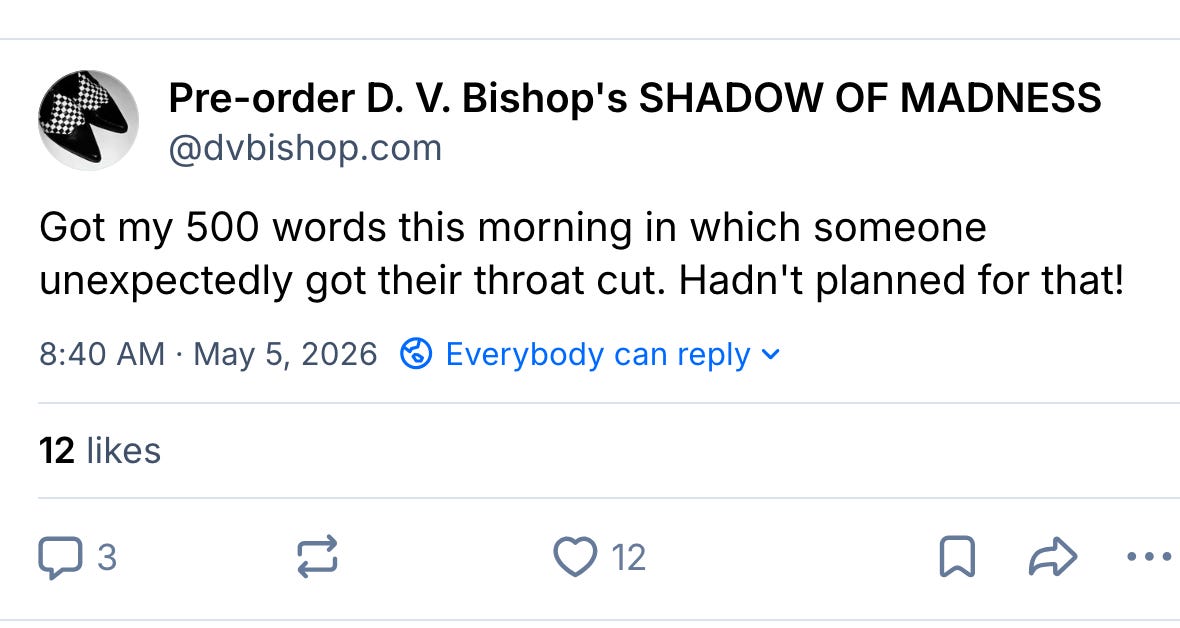
Last Tuesday at 8:40am I went on social media (see above) to mention having achieved my 500 words (I was busy teaching for the rest of the day), and that ‘someone unexpectedly got their throat cut. Hadn’t planned for that!’ This was all true. In the middle of the scene, a character was brought into the room and brutally murdered.
It came as a shock to almost everyone present, and it certainly surprised me. I’d had no intention of slicing someone’s neck open in that chapter, but this visceral killing opened up all sorts of exciting new directions for my WIP (along with an artery). I got on with my day, pondering what should happen next after this abrupt plot twist.
Nagging doubt ahoy!
Yet as the day unfolded, doubts starting to creep into my thinking. Yes, the sudden murder certainly upset the narrative apple cart, but progressing on from that startling moment would definitely send the story into uncharted and very unplanned territory, delaying the midpoint dilemma for my protagonist for another chapter or more.
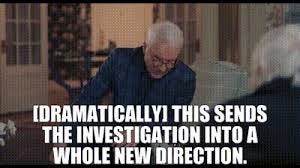
That could be overcome, but I had another worry which was undermining my 8:40am joy: did this killing belong in the novel? Yes, the book is a historical thriller so there will be jeopardy and murders. But my WIP also has a lighter tone than the Cesare Aldo historical thrillers, a more playful character to its storytelling.
Establishing the right tone for a novel is hard enough (as discussed here), but maintaining that tone can be equally challenging. You have to hold on to the book’s distinctive feel. If it is all sturm und drang, then a sudden lurch into slapstick comedy will jar. If the book is more cosy than noir, it needs to stay on that path.
The solution was simple enough: I cut nearly 700 words out of the manuscript, saving them in another word document when I keep all the offcuts from this novel in case they’re needed. Then I returned to my original notion and wrote the sequence as it should have been, leading up to the protagonist’s fearful realization.
Being able to recognize a misstep as it happens (or soon after) is a useful skill for any author. You need to sift through your usual self-doubts to hear that writer’s instinct telling you to pause and examine an errant strand within your novel as a whole. That gives perspective to decide whether to keep going or back up.
Why do missteps happen?
There are many reasons for novels going astray. A writer might be bored with their story and decide to hurl a metaphorical hand grenade into the narrative. Perhaps they favour Raymond Chandler’s suggestion that the best way to write your way out of a hole is to have a guy come through a doorway with a gun.
Sometimes enthusiasm gets the better of writers. So much of drafting is about improvisation, even when the author has a full plan, synopsis or chapter breakdown at hand to guide them. It can be very tempting to go freestyle, letting the characters have their head and roam wild to see where this takes the story.
Putting the pieces back together • Photo by Kelly Sikkema on Unsplash
That willingness to experiment, to play with what seems like a better idea and see what emerges from that can lead to exciting new narrative strands. I’ve been known to throw my loose plan out the window at times, often to fruitful effect. But doing this demands you recognize when the new direction is going wrong, and undo the damage.
The unscheduled throat-cutting in my WIP was not a response to narrative ennui. Instead, I suspect it was me lapsing into Cesare Aldo mode. Much as I love writing that series, Aldo’s stories often go to some dark places where terrible things happen on the page. But what works for those novels doesn’t always fit this new novel.
Time will tell whether I’ve made the right decision, but the story seems back on track and the tone is being better maintained in my now-revised chapter. You can judge for yourselves when the novel is published in 2027. Once you’ve read it, come to an event and ask me which character got their throat temporarily cut.
Progress report
I have reached the midpoint, as detailed above, bringing the wordcount to 41,500. I’ll now review what I’ve written thus far, and plot the next 20k. I’m on target to deliver by mid-July, all things being equal. Onwards!
If you’ve been forwarded this newsletter by a friend, feel free to subscribe. But if you no longer wish to receive it, click unsubscribe at the bottom of the page.
Good piece, but what’s ‘markiUNng’? I googled it but nothing. Is it University student marking? Something I remember far too well!