
Approaching the midpoint
Never be the same again

Welcome to the free newsletter of David (D. V.) Bishop, author of the Cesare Aldo historical thrillers set in Renaissance Italy. This time is all about the midpoint…
Midpoint imminent
I am fast approaching the midpoint of my work in progress. This is a significant moment in the story, but also a significant moment in the drafting of any novel for me as a writer. It’s akin to reaching the top of a difficult mountain climb. You are very tired, but there’s good news: the rest of your journey is all downhill from there.
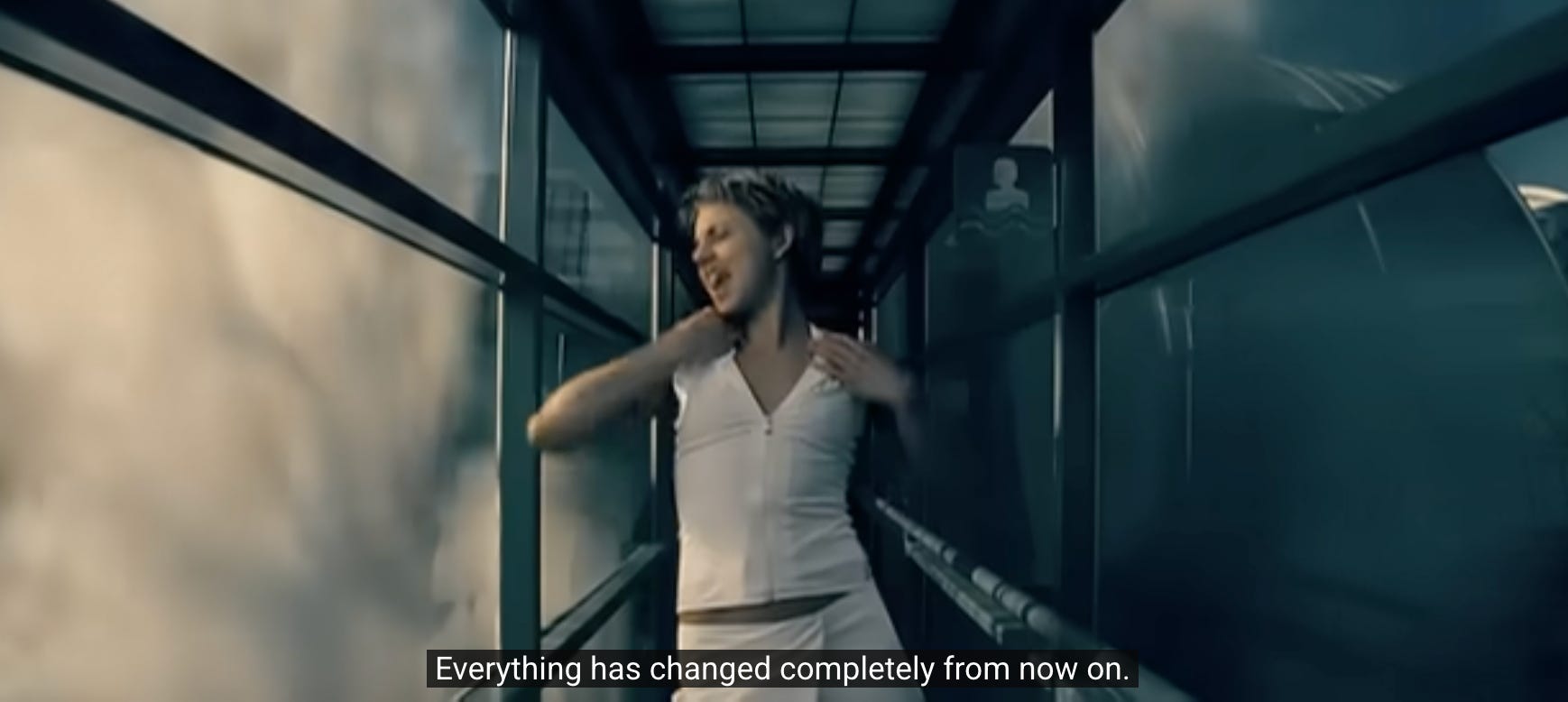
Melanie C singing Never Be The Same Again; oddly the English closed captions on her official YouTube channel have altered all of the lyrics - curse you, AI!
By the time I reach the midpoint of a novel, all my major characters have been introduced, the major plot strands are all set up, and the stakes for my cast are clearly established. There are still big challenges ahead (for them and me) but the task is now bringing it all together in a satisfying conclusion, rather than inventing anything new.
(I have another, less elegant way to describe this when talking with my creative writing students. Drafting a novel is like a giant snake eating a goat. At first, it seems impossible, the goat is too big to be swallowed, let alone consumed. The midpoint comes when all of the goat is inside the snake. The challenge becomes digesting it.)
Put simply, the midpoint is a key moment in the creation of any narrative, often bringing with it a significant pivot for the characters. It can be a hinge joining two halves of a narrative, a place of transition and realization after which nothing can ever be the same again. It’s a crucial moment on the journey for the protagonist.
The last fifty years have seen a lot more focus on structure and on the narrative architecture of storytelling. That’s especially true in screenwriting, but it has seeped into the discipline of creative writing as well. I think it is worth considering some of the ideas that revolve around the midpoint and its significance to storytelling.
Want versus need
Let’s start by talking about narratives where the main character is on a journey of change. They start the story consciously and overtly wanting to achieve or attain something because they believe doing so will make them feel happier and far more complete as a person (or at least rather less broken, in some cases).
But such characters are often chasing the wrong thing. Even if they do achieve or attain that one goal, it won’t have the desired effect because they have an underlying need far more significant to their wellbeing. Until that need is acknowledged and pursued, all the wants in the world will not solve their true (if hidden) problems.
Couldn’t find the Shrek GIF I wanted, so…
Let’s use the 2001 animated movie Shrek as an example. Shrek is an ogre who wants to be left alone, believing that will make him happy. People have attacked Shrek his whole life because he is an ogre, ugly and fierce, seen by others as something to be hated. Shrek has decided being alone will stop everyone from attacking him.
Having internalized all that hatred and abuse, Shrek perceives himself to be ugly and fierce, a monster to be driven out. Shrek believes he cannot be loved, and can never have any friends. To protect himself from pain, Shrek chooses to drive everyone else away. Therefore his flaw is a fear of vulnerability, of daring to hope for love in his life.
Yet Shrek’s need is to be loved, to be appreciated, to have friends. That means his want – being left alone – is the exact opposite of what he needs. If Shrek does get what he wants, he will never be happy, will never become more complete or less broken. He must sacrifice pursuing what he wants to have any hope of attaining what he needs.
Midpoint as structure
For a character on a journey of change, the midpoint is where they realize chasing their want is not the solution. Instead, they must recognize what it is they need and pursue that. This can involve significant sacrifices, setting aside their pride to ask for help, or being willing to get hurt in the hope of attaining the thing they need.
That’s how the midpoint can function at a character level, but it also shows up in structure and plot. Any midpoint worth the name pivots on a turn or a reversal in the story – and what that forces characters to decide. It should require the protagonist to make a difficult choice they’d rather avoid, and have them confront the consequences.
When a rocket ship sets off, there are a series of go/no go moments in that journey. At each stage, choices must be made about whether to proceed or not. Go for launch or delay? Land on the Moon or return to Earth? (Yes, I re-watched Apollo 13 recently after Artemis II returned. ‘We lost the Moon’ is such a killer line in that movie.)
The same can be true of story structure. Characters get pushed into making difficult choices, with each successive decision proving harder than the last one as the stakes are continually raised. The midpoint is not the ultimate dilemma, but it often requires a protagonist to make an irrevocable choice. Nothing will ever be the same again.
For my work in progress, the midpoint makes the protagonist realize that to succeed they must do something that transgresses all of their moral boundaries. Refusing to break those rules guarantees failure, but violating the code by which they have lived their whole life can never be undone. Hopefully this will make for a juicy dilemma!
Progress report
Work continues on my 2027 novel. The current draft is approaching 40,000 words as I type this newsletter, meaning I remain on target. After reaching my midpoint I shall pause to review what I’ve written thus far, and plot the next 20k. It will be bumps along the way but it should mostly be downhill from here. Onwards!
If you’ve been forwarded this newsletter by a friend, feel free to subscribe. But if you no longer wish to receive it, click unsubscribe at the bottom of the page.
This landed in my inbox as I literally hit the midway point of my current WIP. Just what I needed to read. Thank you!