
The Right Tone
Writing’s invisible challenge

Welcome to the free newsletter of David (D. V.) Bishop, author of the Cesare Aldo historical thrillers set in Renaissance Italy. This time: some musings on tone…
It’s tricky
I’ve been teaching postgraduate creative writing since 2009, a date so long ago it’s surprising dinosaurs were not still walking the earth back then. Over the years I have helped hundreds of students with thousands of stories, yet teaching them has also taught me a lot because the job makes you examine different aspects of the craft.

One size never fits all • Photo by Patricia Serna on Unsplash
Writing rarely responds to a one-size-fits-all approach to problem solving, just as there is no single way to tell every story. A technique which might fix one narrative issue will be of no use at all for the problems in another. Then there’s the fact each writer has a methodology that differs from every other writer in some subtle way.
But of all the challenges that new, emerging, and established writers face, the one I find hardest to explain and help them resolve is tone. This is the invisible conundrum, the thing where a reader can instinctively tell when it has gone awry without really knowing why it has gone awry. Something in the narrative just feels… off.
Maybe the characters are bouncing along happily but events take an ill-convincing turn for the worst. There is a 1990s film in which the two main characters are laughing themselves silly but one of them suddenly collapses. A few scenes later it’s revealed she has cancer of the spine and will never walk again. Crikey!
My memory is this comes out of nowhere, changing the film from an ugly duckling romcom (albeit with some bleak moments) to a much darker drama. That veers perilously close to tonal lurching, where a story suddenly switches from one tone to another without having set this up or signaled it was coming for the audience.
So, what is tone?
Good question, and one that is hard to answer without reaching for words like ‘feel’ or ‘vibe’. Tone is a nebulous term which gets thrown around a lot yet is rarely well defined. Essentially, it is all about attitude. This can come from the author, the narrator of a story, or be created through a particular character in that tale.
You might think of tone as being a mood or emotion that encompasses a story. Constituent parts of that narrative – characters, their behaviours or story arcs, for example - can be very different from it, yet the overall tone remains cohesive. There can be comedic characters in dramatic stories, or dramatic arcs within comedies.
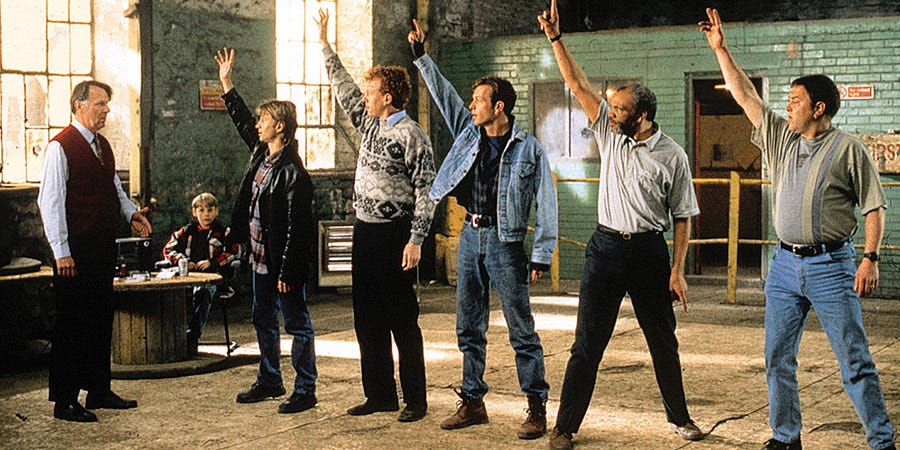
The Full Monty (1997), screenplay by Simon Beaufoy.
The Oscar-nominated comedy The Full Monty is a great example of this. Six men grappling with redundancy reinvent themselves as male strippers for one night to raise money so their ringleader can pay the child support needed to see his son. The film deftly strikes a tricky balance between comedy and drama, slapstick and pathos.
Tone can vary at a character level, at a plot level, and also at an overall level. In cinema this is crafted in many ways – through the writing, directing and acting, obviously, but also through the music, the lighting, how events are edited together, and so on. All of them come together in The Full Monty to make a gem of dramatic comedy.
When it comes to prose fiction, the author has only some of those tools available. Plot, pacing, syntax and imagery can all help craft an overall tone. But essentially, it comes down to the words. Every sentence, every phrase, every piece of punctuation can and should help to build and activate the intended tone of that narrative as a whole.
First sentence first
I’ve talked before about the trick of confidence, the way a writer demonstrates a firm grasp of their story and its characters through assured prose from the first sentence to the last. But a great opening can also help to establish tone. It makes a contract with the reader, a promise which announces itself by saying ‘I will be this kind of novel’.
I believe if you can nail the opening line of a book, what follows will be that little bit easier. Finding the right first sentence to suggest and established the tone of everything after that beginning is invaluable – and therefore also very, very hard. Let’s consider a few examples so you can perhaps see what I’m trying to say…
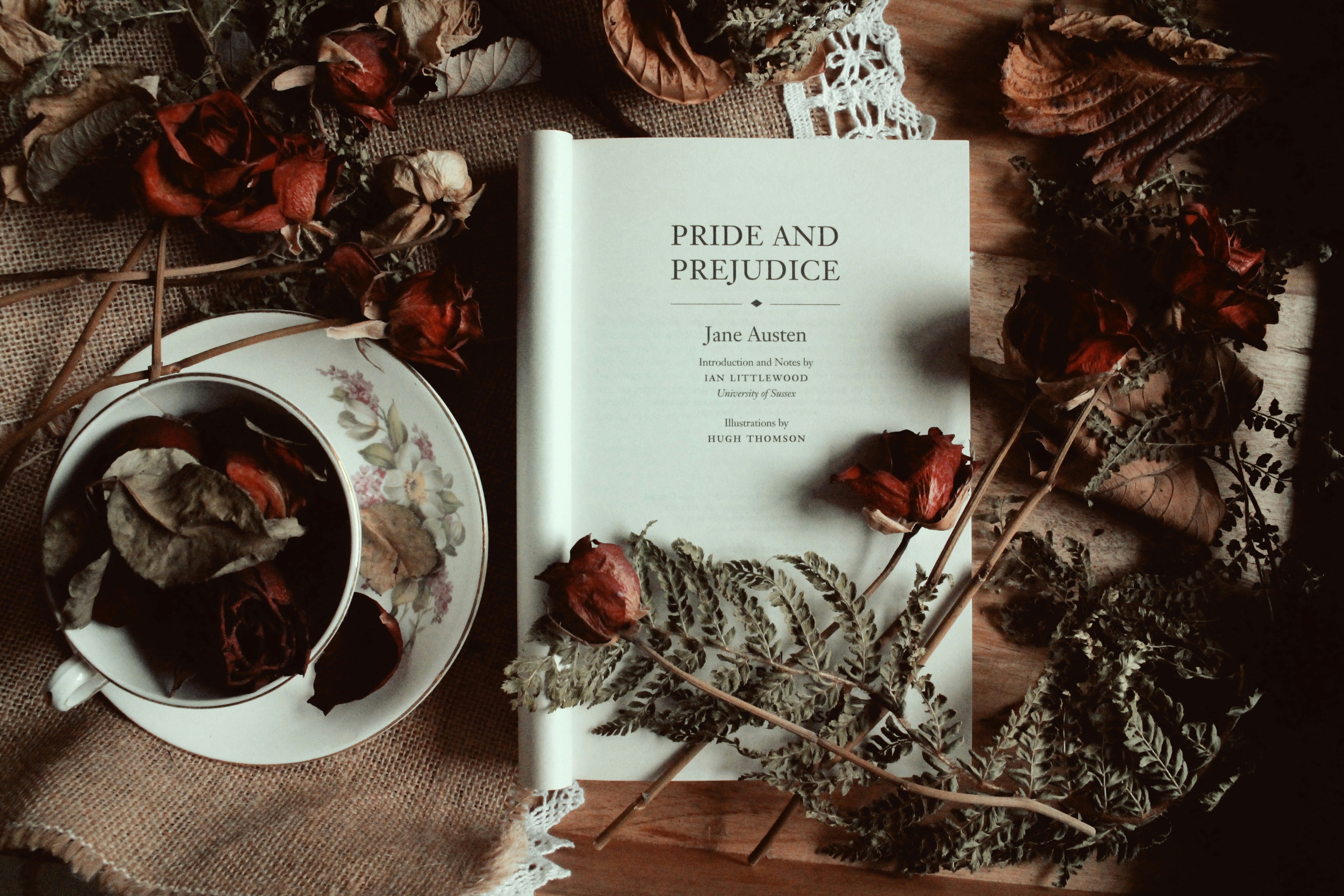
Pride and Prejudice • Photo by Elaine Howlin on Unsplash
It is a truth universally acknowledged, that a single man in possession of a good fortune, must be in want of a wife. Jane Austen absolutely nails this, establishing both the plot and tone of Pride and Prejudice from her first line. You know there will be snark, there will be humour, and there will be romance.
It was a bright cold day in April, and the clocks were striking thirteen. George Orwell grabs your attention at once in 1984, but he also sets up a world which is both familiar and wrong, a place where it seems nothing you might expect to believe in cannot be trusted, where truth is bent and twisted and broken to suit the needs of the state.
Cesare Aldo took no pleasure from killing, but sometimes it was necessary. Yes, I just quoted the opening line of my first historical thriller novel, City of Vengeance. No, I’m not comparing that to the genius of Austen or Orwell! But devising this first sentence helped me lock down the tone for Aldo as a character and for the whole book.
You read that opening and know there will be violence. That Aldo has killed before and, if required, he will do so again. The sentence tells you a lot about his character, his attitude – his tone. It also suggests a tone for the rest of the novel, and indeed those which follow it. This is why knowing and nailing tone matters for writers.
Just for fun, here is a draft of the opening paragraph from my work in progress which aims to estbalish the tone for everything that follows it…
My name is Contessa Valentine Coltello, and I have been accused of murder. I am writing this confession of my own free will; I have not been coerced, threatened nor tortured into doing so. I shall tell the whole truth about what has occurred here, both to make sense of these events and to spare others further suffering. Well, it seems the least I can do.
Progress report
Work continues on what should be my 2027 novel. Editing Act One cut 700 words from the draft (often the case), shrinking it back to 19.5k. But work is now underway on the first half of act two, and I’m aiming to reach 25k by the time you read this newsletter. Keep your fingers crossed for me. Onwards!
If you’ve been forwarded this newsletter by a friend, feel free to subscribe. But if you no longer wish to receive it, click unsubscribe at the bottom of the page.
"she's"... Apologies
I hear her voice (Dogtanian cartoon Milady...) and know whes already manipulating everyone around her, including this dear reader...