
Page against the machine
Does AI fiction smell like Temu spirit?

Welcome to the free newsletter of David (D. V.) Bishop, author of the Cesare Aldo historical thrillers set in Renaissance Italy. This time: AI does not an author make…
Artificial? Yes. Intelligence? Hmm…
Last month the New York Times featured an interview with a romance author who uses AI tools to ‘generate’ (her words, not mine) a full-length novel in under an hour, a task which used to take that writer weeks or months. The author said they had published 200+ such books in a year, was selling 50,000 copies and earning six figures.
The article generated a lot of hot takes, horrifying some and perhaps persuading a few people to follow the same, seemingly lucrative path themselves. Making a great living while letting a machine do all the work sounds tempting, right? But something which looks too good to be true often proves to be just that: fool’s gold.

An example of budget-friendly, trend-driven items from days of yore. How many playlists include covers of the Sex Pistols, Donna Summer and Fanfare for the Common Man?
Having AI generate a novel by engineering a few prompts reminds me of fashion behemoths like Shein and Temu. Such companies offer thousands of new budget-friendly, trend-driven items every day to online customers. That’s right, thousands of new lines every day. These near-instant releases are often called drops.
It can’t be long before some corporation realises that there is money to be made from drops of budget-friendly, trend-driven, AI-generated novels. If an independent author can make six figures a year doing this, why can’t a corporation scale that by a factor of thousand and make millions of dollars from selling new story slop every day or hour?
There are already some publishers explicitly stating HUMAN AUTHOR on their book now. What comes next? Will they have to rebrand themselves as haute auteur houses, and charge more for a novel that’s actually been written by a person? It sounds fanciful, even absurd, and yet… the past offers an example of a similar situation.
Smells like Temu spirit
Long ago the music industry had a sub-genre of low cost sound-alikes, whole albums packed with remakes of current hits. These weren’t cover versions that added a fresh twist to each son; no, they aimed to be as precise a copy as possible yet be on sale for a bargain price. You can read more about this lucrative music sub-industry here.
By far the longest running and most successful were the Top of the Pops albums which were released from 1968 to 1985. In its wisdom the BBC hadn’t trademarked the title of its long-running TV series, so the name got appropriated by some canny, shameless producers to persuade the public there must be a connection between them.
Another lively strand of this sound-alike sub-industry was releasing albums devoted to a particular artist, with front covers crafted to fool people into believing these were the originals. The subject’s name would be in huge type while the actual recording artist was mentioned but much smaller. Witness the Tom Jones sound-alike below…

Wonder what happened to Danny Street and the Alan Caddy Orchestra and Choir…
What does this remind you of? Does using the cheapest, quickest means to jump on a bandwagon and sell knock-offs of other people’s creativity sound familiar? (No pun intended!) After all, why work hard to make something new when you can scrape a living from the unique inventiveness of others…
This comparison isn’t absolutely like for like, of course, but it does offer a glimmer of hope for authors feeling overwhelmed by the rising tide of AI slurry. The sound-alike industry died away because people preferred the real thing to pale imitations. Human imagination still surpasses machine-made because of our quirks and idiosyncrasies.
AI is a tool, not a replacement for creativity
I have no objection to people using AI as a tool to help them write, each to their own. But I believe having a machine supplant your creativity is a mistake, and that’s before we get into the piracy of those AI systems which have illegally scraped millions of published novels to train software without permission or paying for the privilege.
Even if you built a Large Language Model (LLM) trained solely on your own writing, I doubt the stories it generates would have your inherent inventiveness or individual creativity. A copy is still a copy, a fake is still a fake, and a knock-off is still a knock-off, no matter how good a simulacrum might be at rearranging words and sentences.
When creating something new, the hard work is an intrinsic part of that process. It is having the idea beyond your initial impulse that leads to better stories, it is the challenge of overcoming problems which helps you find more compelling narratives, and the sifting of ideas good or bad that enables you to make something of your own.
You might not make as much money as someone who gets software to generate entire books for them, but surely you became a writer to write? You have a compulsion to do this, there are stories you absolutely need to tell. After all, a writer writes, as Billy Crystal says in the film Throw Mama From the Train - not a writer engineers prompts.
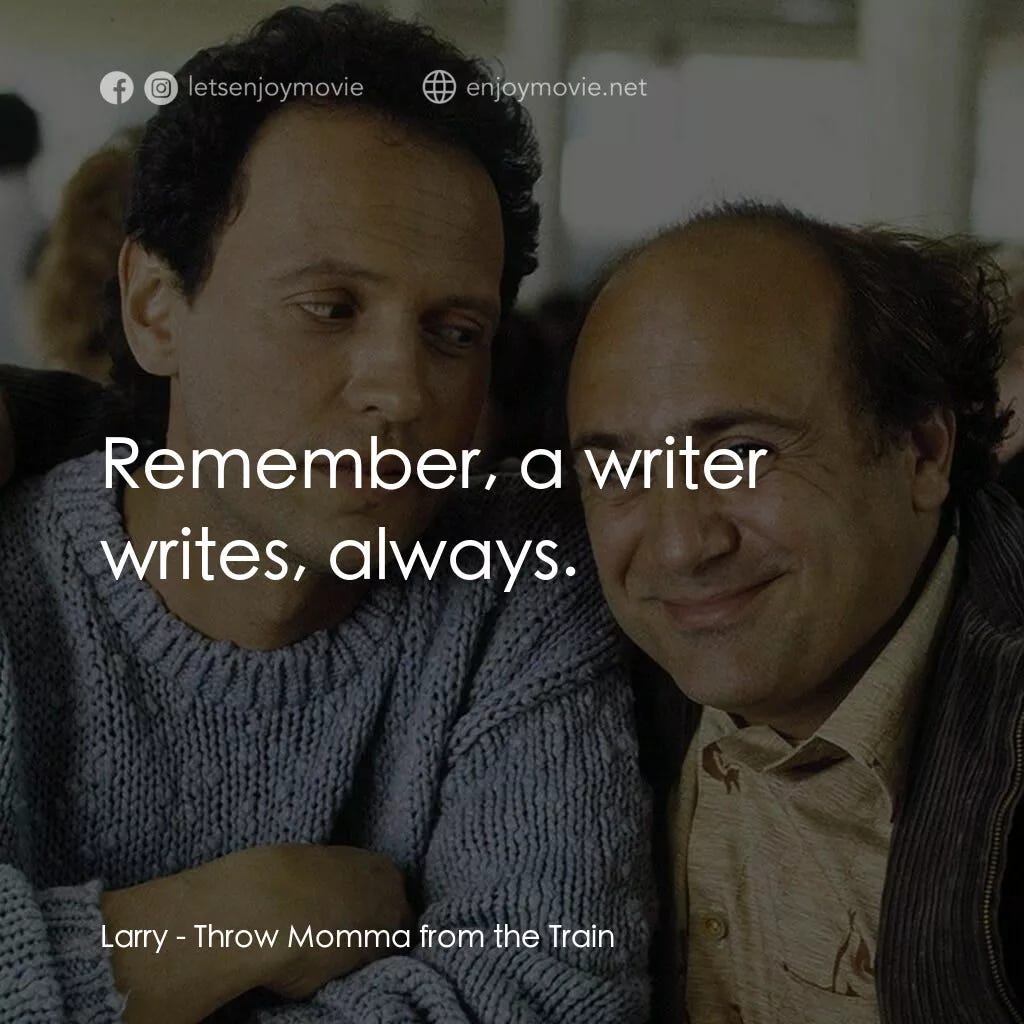
I write because I must, because it keep me as sane as I am, and it helps drain my over-active imagination. When I’m between books, my night dreams become so vivid it gets disturbing. But when I have a new work in progress, that’s less of an issue. So I shall continue with my own plodding way, pitting the page against the machine.
Writing update
Speaking of writing, work continues on my 2027 novel. I’m writing this newsletter first thing on Saturday and as of Friday had reached 7500 words, with more to come over the weekend and into Monday. My next goal is to hit 20,000 works by the start of April. I shall report back again soon on my progress. Wish me luck…
If you’ve been forwarded this newsletter by a friend, feel free to subscribe. But if you no longer wish to receive it, click unsubscribe at the bottom of the page.
AI has been a focus of my last couple of articles. My take is there will be a slush pile of AI pseudo-art that will make money but it will be the Michael Bay Transformers of it all… stuff no one with any sense really likes and leaves no impression. Authenticity is, I hope, the thing that’ll keep flesh and blood art alive. Hacks will generate novels in a day, real artists will do it themselves.
I'm not quite sure what the AI 'writers' goal is tbh. Do they have a wildly unrealistic idea of how much money a writer makes? Do they think we're doing it for the huge amounts if money, rather than the love of it? Very strange. I guess I can understand, say, a computer game company trying to dump its writers in favour of ai (I think they're wrong and idiotic but I can see a point) and I can understand random people using ai to write their emails but writers themselves going over to it doesn't make any sense to me.