
Close (To The Edit)*
When should you revise/rewrite?

Welcome to the free newsletter of David (D. V.) Bishop, author of the Cesare Aldo historical thrillers set in Renaissance Italy. This time: the art and noise of editing…
First things first
Before saying anything else, it’s worth saying this: there is no single right way to edit a novel. Almost every writer I know has a different method for the task of crafting the best version of a story. Most evolved their approach through trial and error over multiple projects to find a way that works for them.

There is always more than one way • Photo by Brendan Church on Unsplash
Some writers consider editing their favourite part of the process editing, while others despise it. Editing can be where they start turning raw material into a recognizable story, but others see it as honing and polishing to finesse the underlying themes and fine details after the main creative work has been done.
Whatever the attitude, whatever the approach, editing is a vital part of the writing process. Rare is the manuscript that emerges perfect at the first attempt, especially for a novel. The white heat of pure creativity might produce a short story or poem that needs little editing, but few can write a novel in one sitting.
Of course, what writers call a first draft varies wildly. To some that is an initial, messy blurt of words (sometimes called a vomit draft). Others produce a first draft that is quite polished; chances are, this has seen some edits during the creative process. Again, there is no single right way to write or edit a novel.
Editing is largely the process of honing a narrative so I’d suggest it is more about craft than art, yet when and how you edit can also inform and influence the act of creating a story. Drafting and editing can be separate or intertwined, with editing done before and after or during and alongside drafting. Mileages may vary, caveats abound, etc.
Getting Closer
In what follows I’m discussing the edits that happen before an entire manuscript gets sent to an agent, editor or beta readers. Some writers share their work in progress (WIP) for an external sense check, which can be helpful (I did with my WIP as it’s a new thing). But here I’m discussing an author’s own editing process.
Self-editing isn’t easy, but you have to keep going • Photo by Drew Beamer on Unsplash
There are writers who edit as they go, reviewing and tidying the previous day’s work before plunging into whatever comes next. (I know a television screenwriter who re-reads the entirety of his WIP each day before adding to it. Of course, most television screenplays are well under 100 pages, whereas a novel can takes hours to read.)
Other writers focus on getting words on the page as fast as possible. They blast out a manuscript, not caring if character names change or other mistakes creep in; those can all be corrected later. The goal for them is momentum, reaching The End while inspiration burns hot. Their first drafts are messy, but get written a lot faster.
The level of pre-writing undertaken can have a significant impact. If you spend time crafting characters, story and structure in advance, there are fewer decisions to be made while drafting and the words often come faster. But pre-writing is an anathema for many writers as it kills the joy in their creative process.
Whether a story is invented and shaped by pre-writing, through drafting, or via self-editing of a completed draft, any novel takes as long as it takes. Accepting that is a necessary step to your method as a writer. There are no easy shortcuts, it is a job of creative work. That work should be part of the pleasure, so why not revel in it?
Questions to answer
I repeat: there is no single way to edit. That said, I think it’s valuable to step well back from your prose to consider some broader questions. For example, what is the purpose of your draft? How would you like it to hit the reader? Will it engage their empathy, activate them as a narrative detective, or perhaps do both at once?
What promise does it make in the opening pages, and is that promise delivered by the closing chapters? If you believe the story occupies a particular genre, what expectations of that genre does your draft meet and which does it subvert? What metaphor might be used to capture or describe the essence of your narrative?
So many questions… • Photo by Etienne Girardet on Unsplash
What meaning or question(s) do you hope people will take away after reading the final page? How do you want them to feel after finishing the book, and therefore what tone is it trying to evoke? How consistent is that tone, and are there elements of the narrative which threaten to undermine what you’re aiming to do?
What narrative position(s) are you using across the totality of the novel, and how effectively are these being deployed? Have you included one simply because none of your main POV characters are present to witness particular events? If so, is this the best solution or might there be another way of achieving that?
What kind of narrative structure does your story employ? How well is that working? Are all of your characters justifying their presence on the page, or could some be culled/combined? Might you need cast additions to make the novel flow better? Does your plot rely too much on coincidence or contrivance to effectively function?
If you can give satisfactory answers to all of those questions, well done! Now you can move on to fixing the actual prose. But if you still have big ticket items like purpose, theme, tone, narrative position, structure, characterisation or plot to resolve, better to tackle those before worrying about errant spelling and dodgy punctuation.
Wallace and Gromit method
I’ve described this before but that was quite a while ago, so here’s the Wallace and Gromit editing method I use while drafting a new novel. It helps me ensure the plot is being driven by what the characters know and feel, so their individual motivations shape how the story unfolds, rather than me forcing them into unearned actions.
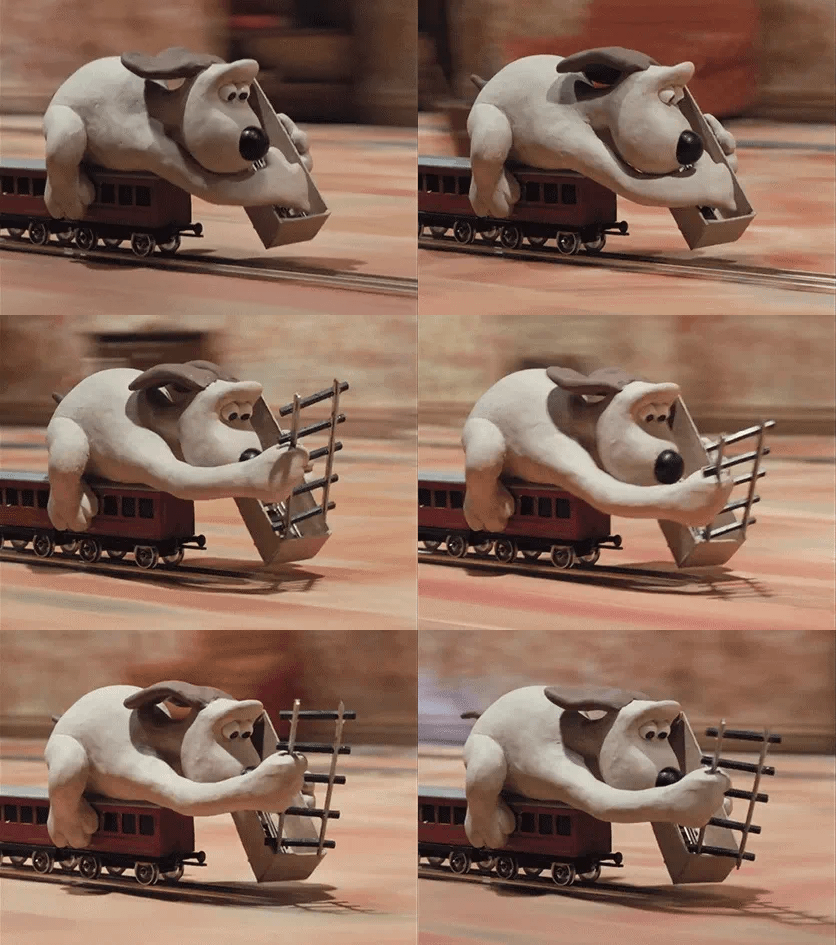
Like Gromit, I aim to have just enough plot in front of me to keep going forwards…
Having completed the first act of a novel (usually around 20,000 words), I will print the whole thing out and read the pages out loud. I make notes on the manuscript as I go, such as missing opportunities and story beats, ineffective dialogue and character missteps, plus identifying the obvious surface blemishes to tidy up.
After each chapter in the manuscript I make a note of what happens to whom, how they feel about this, and where it might lead them later. I find it’s a lot easier to make editorial decisions by looking a big picture version than while faced with dozens and dozens of pages of draft prose. Macro beats micro at this stage, for me at least.**
Having created my bare bones summary and put the surface edits into my first act, I step away from the screen and shift to scrawling scene ideas on individual Post-It notes. I let myself play, using what the characters know and feel as my guide along with cause and effect. If someone does this, how will others respond to that, and so on.
I sift all these ideas, putting them into a logical order of occurrence and then type those out as a series of plot beat bullet points. Now I’m ready to start drafting, always keeping with just enough track in front of me to get the story moving forwards. Once the next 20,000 words is written, I repeat the process again and again until The End.
Progress report
I’ve reviewed the first half of my WIP, cutting 1300 words out of it and plotting out the next quarter of the narrative. Work on drafting that has begun, and I’m still just about on target to deliver by mid-July. Keep your fingers crossed for me. Onwards!
If you’ve been forwarded this newsletter by a friend, feel free to subscribe. But if you no longer wish to receive it, click unsubscribe at the bottom of the page.
*If you’re very old, you’ll know this week’s title Close (to the Edit) refers to a Top 10 single from 1984 by the English avant-garde synthpop ensemble Art of Noise. They don’t make ‘em like this anymore or, if they do, such things don’t trouble the charts:
**I stumbled into this methodology, but Matt Bell suggests a version for after you have a complete first draft in his excellent book Refuse To Be Done. It’s the best How To tome I’ve found for self-editing and rewriting processes, heartily recommended.
I'm not familiar with that Bell book, I'll have to give it a read. Being the process junkie I am, I'm always interested in hearing about new methods and techniques.