
Aldo book bundle contest
Win all five D V Bishop historical thrillers*

Welcome to the free newsletter of David (D. V.) Bishop, author of the Cesare Aldo historical thrillers set in Renaissance Italy. This time: a new competition.
Great prize for UK readers
My publisher Pan Macmillan is running an exciting promotional competition to win a bundle of five Cesare Aldo historical thrillers. The winner will receive a hardback edition of the new Aldo novel, Carnival of Lies, along with paperback editions of the books 1-4: City of Vengeance, The Darkest Sin, Ritual of Fire and A Divine Fury.
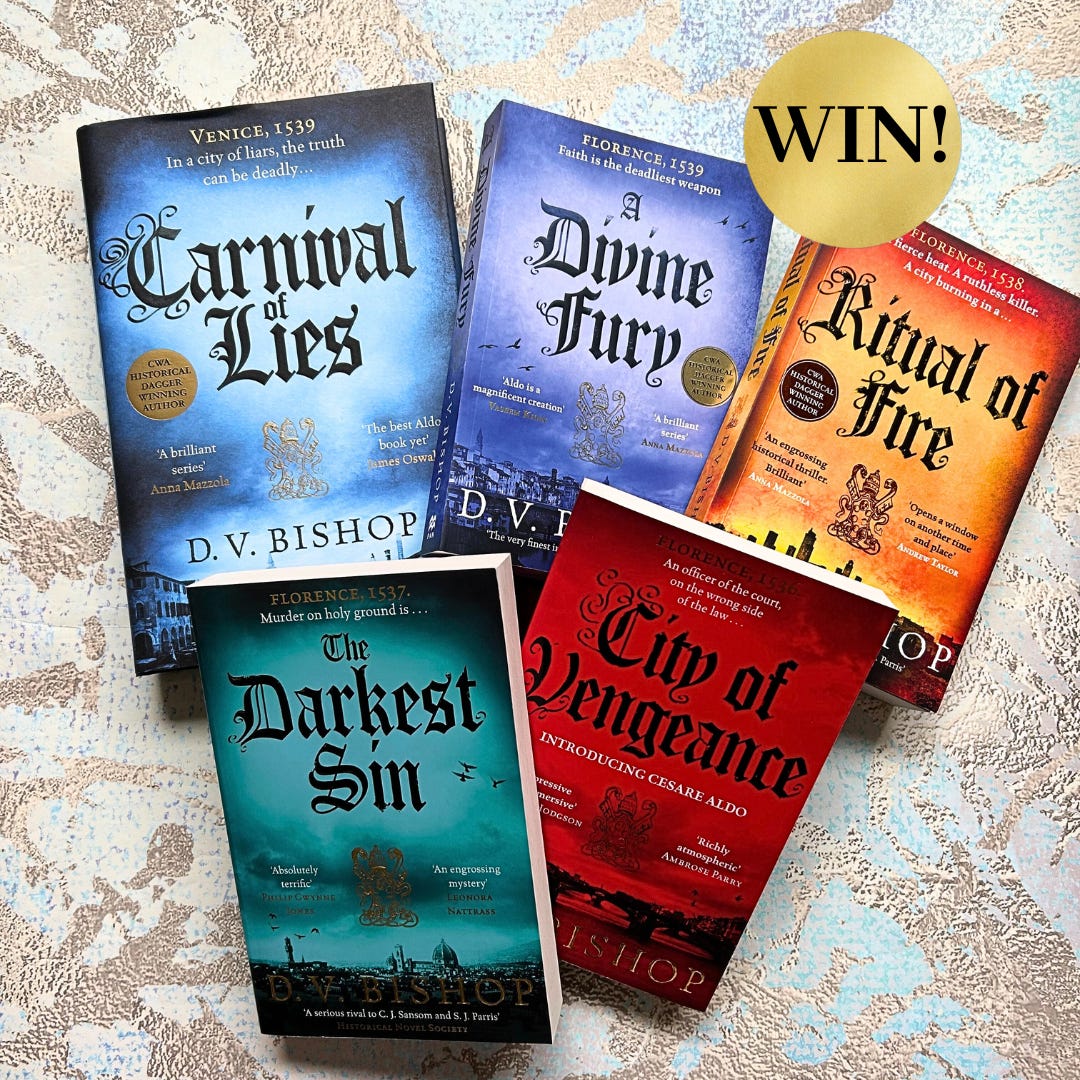
There are also two runners-up prizes where those entrants will each be sent a Carnival of Lies hardback. The winners will be notified in an email from the Pan Macmillan promotions team within 30 working days of the competition closing date. Full terms and conditions for this promotion can be found here.
Please note the following! * To enter you must be: (a) a resident of the United Kingdom; and (b) aged 18 years old or over at the time of entry. The competition is open for entries between 09:00am on 28/07/2025 and 23:59 pm on 11/08/2025. You can enter by visiting this website. Only one entry is allowed for each eligible person!
Writing to be read
Four days a week I lead postgraduate creative writing programmes at Edinburgh Napier University. As part of that, I interview almost everyone who joins our MA – and lots who don’t make the cut for all sorts of reasons (they’re not ready for it, we’re not the right programme for them, moving to Scotland proves impractical, etc).
The first question I ask applicants is simple and complicated: what is your creative writing for? This prompts many answers. A lot of people initially say they write for themselves. This is a perfectly valid response. Writing as a form of self-expression is a great hobby, a way to make sense of things or lose yourself in the act of pure creativity.

Photo by Aman Upadhyay on Unsplash
Other applicants say they write stories to entertain, to connect with others, or to provide an escape – again, all sound responses to the question. Some applicants have a clear sense of purpose to their writing; it’s a means to consider questions or ideas that activate them, perhaps even to plant a seed in the imagination of potential readers.
Let’s be honest, the question what is your creative writing for is a big ask! It prompts soul-searching, because hidden behind that question are other ones: what is your purpose as a writer? Do you create for yourself or for others? Can you do both at the same time? Why do you write, and what do you hope that writing can achieve?
We ask the question because how someone answers reveals an applicant’s attitude to their writing. Are they thinking of themselves or about potential readers as part of the creative process? Our MA spotlights popular genre fiction and professionalising our writers’ practice, so applicant with a reader focus do well with us.
Considering the reader
I listen to a lot of podcasts that interview other writers. (I’ve appeared on a few myself – find them under the Podcasts tab on my website – but would love to do more. If you run a podcast that has creatives as guests, reach out to me in the comments below!) One of the questions often asked is does an author think of their readers as they write?
Photo by Tolu Akinyemi 🇳🇬 on Unsplash
Some say they absolutely do not consider the reader. Instead, they focus on telling the story to themselves, letting it surprise and lead them through a first draft. These authors make a conscious (or, perhaps, sub-conscious) effort not to worry how others will respond, preferring to embrace pure creativity as the story finds its own path.
Such an approach can lead to unexpected, surprising places because the author is not striving to meet expectations. The peril is it does not always succeed, even on the writer’s own terms (let alone those of readers, editors, booksellers or the publishing industry). But there is always a second, third and fourth draft to address that!
I suspect most popular genre authors have an awareness of reader expectations, even if they choose to ignore them while first drafting. The more novels you publish, the greater your knowledge of the industry becomes; it’s almost impossible to avoid, unless you disengage from all forms of media and never attend book festival events.
There are times where I wish not to have that knowledge, to create something fuelled by inspiration alone. I sometimes write shorter pieces like this, letting the ideas dance across the page. My story Dani’s Toys started with such a moment, before being shaped into a short film screenplay and, much later, the script for a graphic novella.
Writing past inspiration
Pure inspiration only gets me so far; it isn’t enough for an entire novel. Inevitably, my mind considers the reader. What do I want them doing as they read? Am I activating them as a detective, challenging them to gather the puzzle pieces of my narrative and find the answers for the questions I am asking before I reveal the solutions?
Or am I seeking to engage their empathy, to make readers feel a connection to a character or characters in the story? Hopefully my novels ask questions of the reader and create some empathy, activate both head and heart. To do that, I have to think about how my tale will interact with a reader, how moments in the story will land.

Photo by Thought Catalog on Unsplash
Most forms of storytelling are a seduction. They say to a reader, audience or listener: pay attention to me. I have something to tell you, a mystery to solve, a character with whom you might fall in love or hate. Stick around, there’s more to come. Stick around, while I plant these seeds in your imagination. Stick around, it should be fun.
I once went to a class when the lecturer argued some popular genres get less respect; the list included all kinds of romance writing, plus horror and stories about faith. They argued that such narratives get less respect because reading them acts on your emotions and your physical body, rather than only challenging your intellect.
I don’t have a perfect final paragraph to draw all these thoughts together – sorry! But they’ve been rolling around in my head, so I wanted to share. Let me ask a question instead: why do you read? Is it to be entertained, or challenged to solve a mystery? Or do the characters bring you back because you want to see what they do next?
Put your answers in the comments section below!
If you’ve been forwarded this newsletter by a friend, feel free to subscribe. But if you no longer wish to receive it, click unsubscribe at the bottom of the page.
"Let me ask a question instead: why do you read? Is it to be entertained, or challenged to solve a mystery? Or do the characters bring you back because you want to see what they do next?"
It's a bit like breathing - if my eyes are open, I'm looking for something to read. Inclination added to by circumstances, because if I'm reading I'm not in my own head, I'm somewhere else. Different times, different moods for what to choose and how to get there.
In spite of liking crime fiction I don't usually care that much about the mysteries or puzzles except in how they work on the characters.
The last week of rubbishy articles about how male novelists are being pushed out of publishing in favour of romantasy (usually in scare quotes) says a lot about the respect or lack of given to certain genres, and why. I absolutely don't believe that popular genres can't challenge intellect as well as entertain, though.
It depends what I'm reading as to why. I have to read research articles and text books for work (I've written a chapter in one coming out in September, which was very much written with the students who are its intended audience in mind). I read other non-fiction, such as by Robin Ince, out of both interest and to learn things, but also because I'm a fan and like his writing style. I listen to autobiographies of people I'm fans of, read by them. I read fiction for escapism, a good story with characters in whom I can become invested.