
A Divine Frustration
Behind the scenes on Cesare Aldo #4

Welcome to the free newsletter of David (D. V.) Bishop, author of the Cesare Aldo historical thrillers. This time: behind the scenes of my fourth Aldo novel…
Inspiration
It’s a truth universally acknowledged that anyone creating a crime fiction series will end up having a serial killer as the protagonist for one of their books sooner or later. I decided to do so in my fourth Cesare Aldo historical thriller, combining that with a plot strand about exorcisms in sixteenth century Florence.
Of course, the term ‘serial killer’ wasn’t coined until the twentieth century so Aldo would have to use a different name to describe the murderer he’s hunting in this novel. But that was more inconvenient than a significant issue while drafting the manuscript. No, all of the big problems were going to come from elsewhere.
The initial inspiration for this novel came from a chance remark made by a guide while I was on a walking tour of Florence. I sign up for a different tour almost every time I return to the city. These mostly tell me things I already know, but there’s usually a useful morsel or quirky fact which provides the spark for a future book.
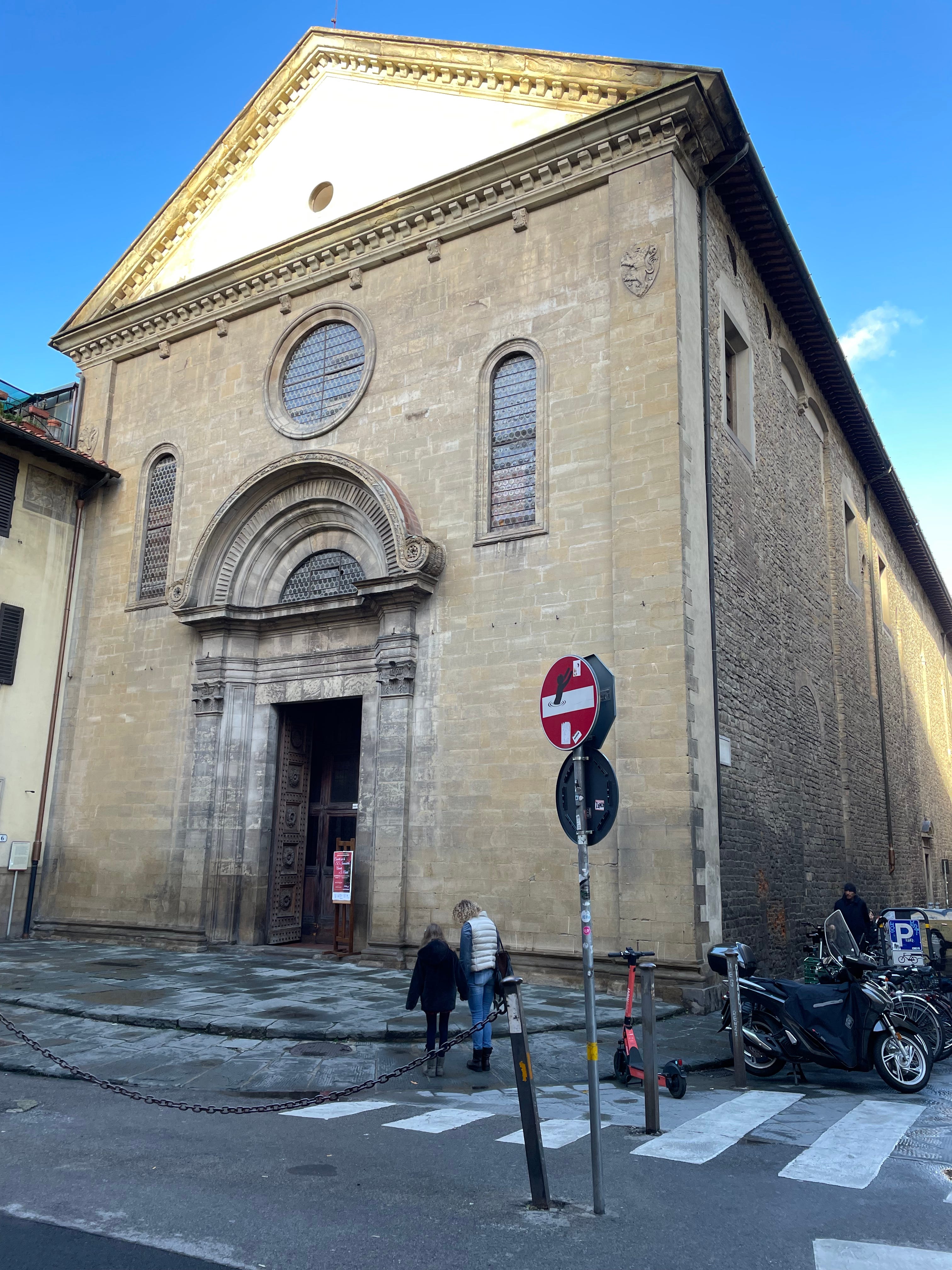
ABOVE: Anyone for an exorcism? The Church of San Felice in Florence
This particular guide mentioned that the Church of San Felice in Oltrarno (south of the Arno) hosts exorcisms on Wednesdays. Why then? I never learned that, but the fact exorcisms were still happening in this century was utterly fascinating to me (blame a too-early exposure to William Peter Blatty’s novel The Exorcist).
It also reminded me I had accumulated several non-fiction books on exorcism in Renaissance Italy as research materials if I ever choose the topic for a future Aldo novel. So, a serial killer and exorcisms – a perfect combination, it seemed. The reality proved to be considerable more problematic, as I was about to discover…
Perspiration
I began drafting the fourth Aldo novel on February 15th 2023. Having written its predecessor in six months, I was confident of being able to do the same again. But I hadn’t banked on the external factors which were to make my life away from writing much more complicated and stressful, destabilising my first draft.
The pandemic was largely in the past for many people by early 2023, but its impacts were all too present. I was leading the postgraduate creative writing programmes at Edinburgh Napier University, for example. During the 2021-22 academic year we’d had to double deliver all our classes due to social distancing rules.
A few days before we started the 2022-23 academic year, a member of our teaching team resigned due to burn out and exhaustion. I was about to launch a new online version of our programme, so handed on-campus programme leadership to another colleague in autumn 2022 – they lasted less than one trimester in the role.
That colleague was rightly signed off sick, and resigned a few months later. By May 2023 the only other permanent team member lso resigned, leaving me to recruit and mentor an entirely new teaching team during the six months while I was trying to write my fourth Aldo novel. It wasn’t exactly ideal in any way, shape or form.
I was struggling to keep everything together. I had to ask for an extra two weeks on my deadline (something I hated); even when I handed the book in, I knew it was not yet fully functional. I had changed the killer’s identity thirty pages from the end but lacked the time to recognise all the problems that was going to cause…
I’ve heard global bestseller David Baldacci say he sometimes has to hand a book in before he is satisfied with it. He calls this a ‘pin ending’, meaning he has to put a pin in it and come back to fix the unresolved problems later. That was definitely the case with Aldo #4, but the pin felt more like it escaped from a narrative hand grenade.
I forewarned my then-editor about this and we worked together to resolve the major problems with that draft. But I knew there was a better version of that novel which I’d never get to write simply because I didn’t have the brain capacity, creative bandwidth or time to give the story the attention that it truly deserved.
Synopsis
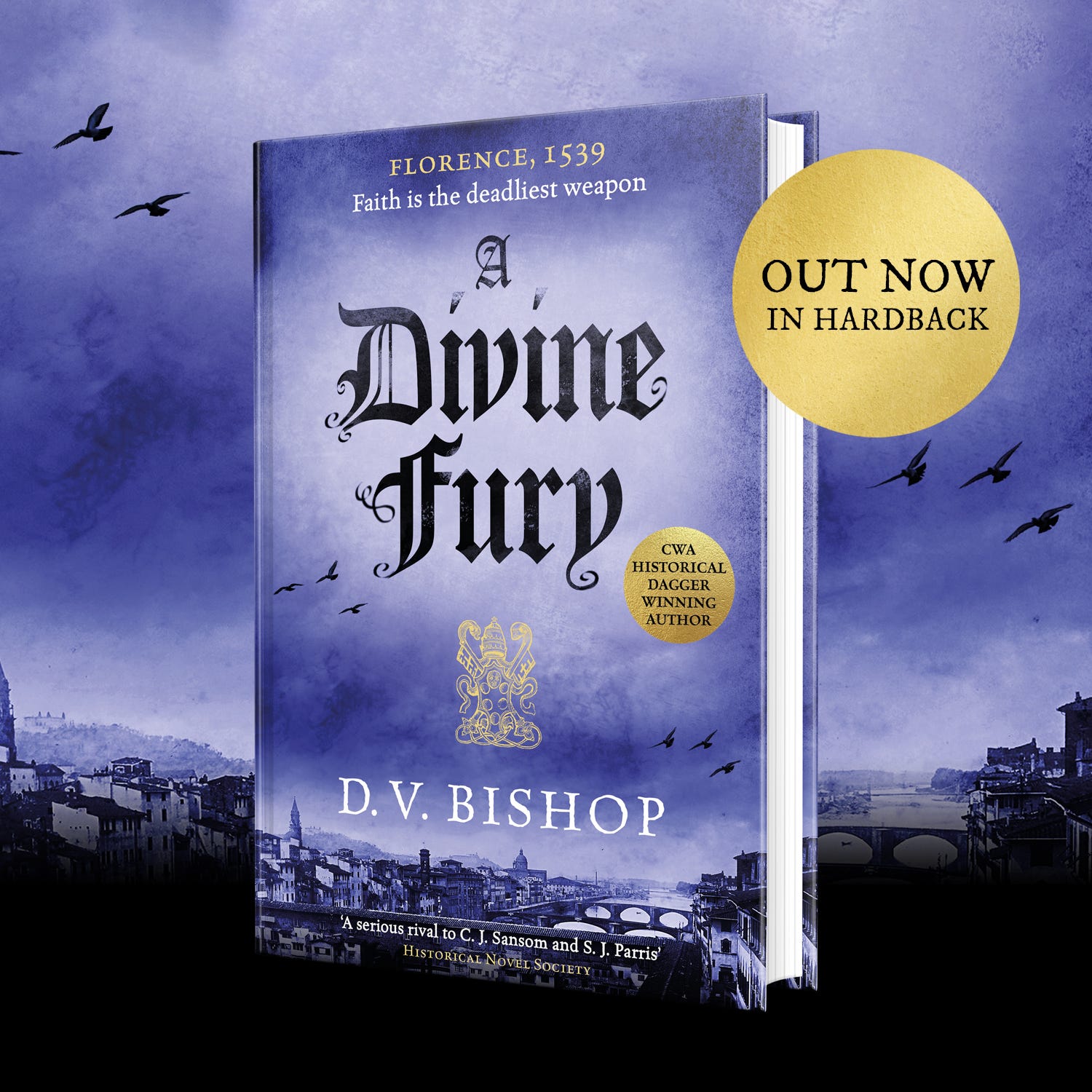
Florence. Autumn, 1539. Cesare Aldo was once an officer for the city’s most feared criminal court. Following a period of exile, he’s back – demoted to night patrol, when only the drunk and the dangerous roam the streets.
Chasing a suspect in the rain, Aldo discovers a horrifying scene beneath Michelangelo’s statue of David. Lifeless eyes gaze from the face of a man whose body has been posed as if crucified. It’s clear the killer had religious motives.
When more bodies appear, Aldo begins to suspect that an unholy murderer is stalking the citizens of Florence. Watching. Hunting. Waiting for the perfect moment to strike again…
Reception
Pan Macmillan chose A Divine Fury as the title for the fourth Cesare Aldo historical thriller, continuing the tradition of me failing to name my own novels. I didn’t even suggest a name for this novel, which says something about its troubled gestation. The hardback, audiobook and ebook editions were all published 20th June 2024.
The lovely people at The Edinburgh Bookshop hosted the launch for A Divine Fury. This event will always stick in the memory because my agent’s aunt asked a question during which she revealed the killer’s name (not once but twice) when almost nobody else present had read the book at this stage! Such is life sometimes…
The novel attracted lovely comments from reviewers and other writers. The Times newspaper said it was ‘full of dash and atmosphere’ while author David Hewson said ‘In Cesare Aldo, Bishop gives us a Florentine Shardlake and this is his best escapade yet.’
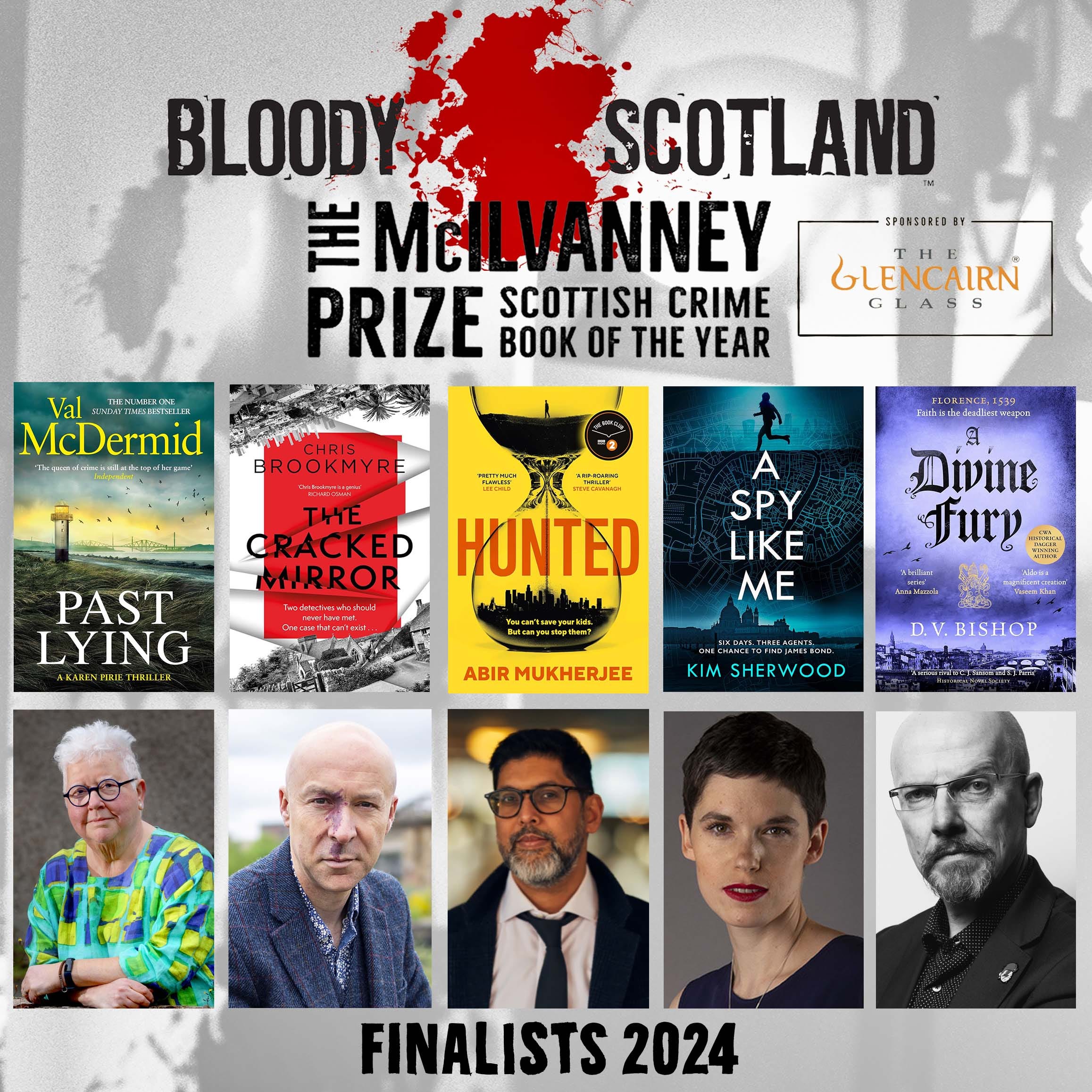
Having had such a torrid time writing A Divine Fury, I was startled when it became a finalist for the McIlvanney Prize in September 2024. The calibre of the other finalists – Christopher Brookmyre, Val McDermid, Abir Mukherjee and Kim Sherwood – meant I knew it wouldn’t win, and it didn’t (Brookmyre did for The Cracked Mirror).
A Divine Fury continued to gather acclaim despite my unhappy relationship with the novel. In summer 2025 it was shortlisted for the Crime Writers’ Association Historical Dagger, and the overall prize of the Gold Dagger. Oddly, I was grateful to win neither as I didn’t believe the novel deserved such accolades.
Reflection
A Divine Fury is my least favourite in the Aldo series to date. Writing it was an unhappy experience from start to finish, and that has coloured my judgement about the book ever since. Thanks to my then editor Alex Saunders, we were able to make the malfunctioning first draft into a novel that read well enough, I suppose.
But I’ll always be haunted by the fact there is a much better draft of it I will never get to write. (No, I have no intention of getting all George Lucas and issuing a special edition in years to come; the published novel will have to do.) Given another three months and more inspiration… but that wasn’t to be.
My favourite part of A Divine Fury is the introduction of Aldo’s new frenemy, the Contessa Valentine Coltello. She was only meant to have a small presence in that book, a small trail of breadcrumbs leading to her much larger part in the next novel. But the contessa stole every scene she was in and demanded more.
I suspect readers will always have more affection for A Divine Fury than I do – and that’s fine. Like most writers with several published novels under their belt, I constantly strive to make the next one better than my last. But this is an impossible aspiration and one I definitely failed to meet with A Divine Fury. Hey ho…
You can hear me talk more about creating A Divine Fury here on The Aldocast:
If you’ve been forwarded this newsletter by a friend, feel free to subscribe. But if you no longer wish to receive it, click unsubscribe at the bottom of the page.
It so generous (and fascinating) to share what a writing life/career looks like in real time. It helps writers see that one better write because one wants to write...the job of writer is demanding indeed. (You may put that on the cover of "No Kidding" magazine.) I have big crush on Aldo, so...back to the audio book for me.
This made me think of the fact Agatha Christie hated the Blue Train because it was written during a particularly awful time - lots of people agree it's not her best but I love it. The flaws are always more apparent to the writer than the fans (but not necessarily the critics/haters).
I hope all the things that were making life hard then are no longer a problem!